Hi everyone! This week’s update features some field photos, a short reflection on being a “professional listener,” and a little more context for life in the Kern River Valley. Next week we start our Western Yellow-billed Cuckoo project, so stay tuned!
Field Photo Update

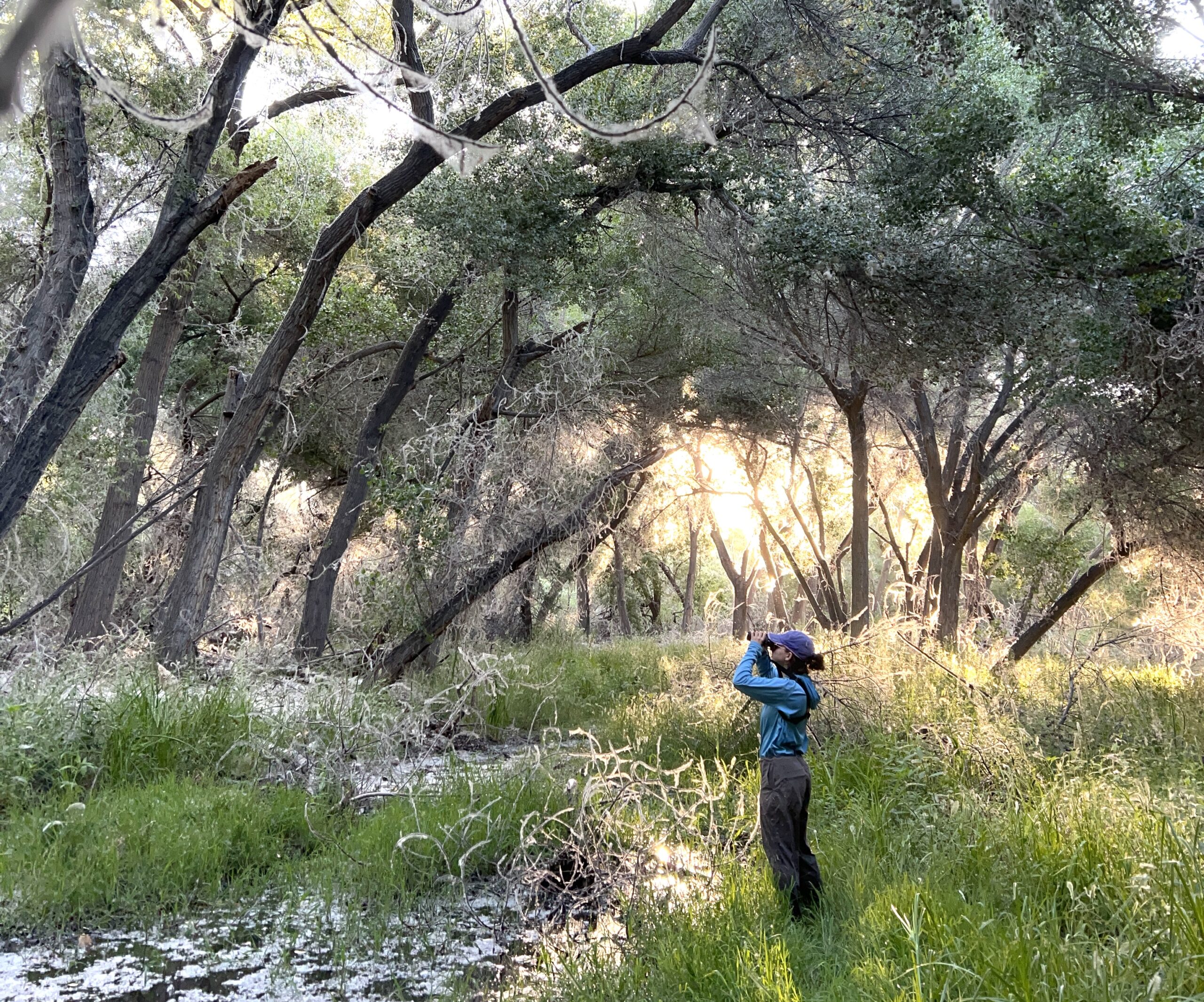
In many cases, the easiest way to move through the forest is by wading through the water. I try to avoid getting in this deep because it is a pain to take everything out of my vest and balance my pack on my head. In this case, though, the water was much better than nettle-lined riverbanks.

I love how the cottonwood seeds outline everything in hazy sunlight. I have found it to be especially beautiful right as the sun rises, and I will pause my fieldwork to snap a quick picture.


We have a few different field vehicles, but my favorite is a faded old Toyota Tacoma. The blinkers don’t work, it smells like years of dust, and it bounces over potholes with undeniable charm.
On being paid to listen
The thing about studying endangered birds, like the Southwestern Willow Flycatcher (SWFL), is that there are so few of them that each detection is newsworthy at the research station. A single song can trigger a chain of follow-up visits, hope, and careful documentation.
This week I was sent on my first follow-up survey. At first, I thought it would be an easy day, as I was instructed to navigate to the last known location of the bird and listen for it for the next five hours. After days of fighting through dense vegetation, I went to bed the night before looking forward to resting my bruised and tired legs. (My roommate jokes that the more bruises you have on your legs, the better you are at surveying. I’m apparently doing great out here.)
After a brief slog through a cattail marsh, I arrived at the detection location. I shoved some branches out of the way, dropped my pack, and settled on the damp ground with my back to a willow. Cottonwood seeds snowed down all around me, catching the sunlight and sticking to my wet pants upon landing. It was a colder morning than expected, and I pulled my flannel closer around me and wrapped my arms around my legs. It was time to listen.
And listen.
And listen.
And listen.
Soon I had a running catalog of all the individuals within earshot. A Common Yellowthroat singing from the top of a tree 15 meters to my southeast. Several Song Sparrows scuffling in the bulrush right behind me. A Bullock’s Oriole in the far distance with its bouncing, cheerful song. I started zeroing in on the smaller noises too, small blips of noises that birds use to keep in touch with each other.
My brain started to swim with the effort of staying focused for a Willow Flycatcher song. It’s a strange kind of work to be still for hours while staying sharp enough to catch a half-second of sound that might not even come. The uncertainty becomes its own kind of noise. I kept scanning the soundscape for anything new, for any sound I hadn’t already traced to a known bird.
After the first hour, the protocol called for playback. I pulled out the speaker, selected the right track, and let the Willow Flycatcher’s fitz-bew echo into the trees. I played a few different vocalizations, each followed by a long wait. Nothing responded.
Five hours later and still nothing. I had done a few laps within a 50m radius of the point, so I pulled out my compass and started wading back to the trail. Even as I walked away, I kept my ears tuned and hopeful. Maybe the bird would call in these final minutes.
More likely, that individual is no longer in the preserve and was just a migrant passing through. After a drought in the early 2000s, the Kern River Valley’s Southwestern Willow Flycatcher population has yet to rebound. With so much habitat loss, there are no nearby populations to disperse into our study area.
Still, I listen. Because even silence can tell a story, and because absence, too, needs documenting.
Where exactly is Ally?

For those of you who like maps, here’s an overview of where I am and how I think about place. I have lived in many new places doing seasonal work, and I like to imagine each new region slowly filling in on my mental map as I explore it. Right now, I’m at the southern tip of the Sierra Nevada mountain range, about a five-hour drive from San Francisco and three hours from Los Angeles. There isn’t much out here except rocky slopes, cattle ranches, and a few scattered towns.
Most of the local communities are clustered around Lake Isabella, a reservoir in the middle of the valley. I live in Weldon, which is little more than a post office and a school. If I drive 20 minutes to the north side of the lake, I reach Kernville, a small, touristy town with a few shops, a cozy brewery that serves good dinner, and some old motels.
If you want to visit a real city with a Walmart, a Trader Joe’s, or anything more specialized, you have two options. You can either brave the winding canyon road west to Bakersfield or head east to Ridgecrest, which is a bit smaller and more limited. Both are about an hour away, and both are reliably scorching, dry, and bright.
To the north stretches the rest of the Sierra Nevada, full of high alpine peaks, granite domes, and sweeping views. If you follow the eastern edge of the range for about three hours, you’ll end up in Mammoth Lakes, a ski town where I once spent a winter working at a ski resort.
Favorite nature moments
The ground out here is muddy, so I’m becoming increasingly interested in tracking! Here is some animal evidence. If you click on the images, they will become full screen. Look at the pictures first and then scroll down to reveal what I think the animals might be.


I am truly not an expert on this, so these are just my guesses.
1. Bobcat
2. Raccoon
3. Bullfrog (this one was a fun challenge that Connor investigated for me. He consulted multiple friends and the consensus was a big frog of some kind, likely a bullfrog)
4. Beaver