Hi everyone! I have only a month left of the field season! Soon this summer will be a memory, and I will be grateful to have these newsletters to look back on. These past three weeks were packed with fieldwork milestones, high-elevation adventures, and a visit from my favorite adventure partner.
Adventures with Connor
Connor is my favorite person to go exploring with. After several flight delays, I pulled around the Bakersfield terminal at midnight to see him grinning at me from the curb, his massive climbing pack on his back, a backpack on the front, and a duffel slung over his arm. I took a few days off, and we were stoked to spend some time camping.
Camping in the Eastern Sierra
Our favorite way to travel is without any plans. We loaded up the car with our cooler, tent, and climbing gear, and we hopped on the highway going north.

Our first stop was the Whitney Portal, and we scored a site at the Mt. Whitney trailhead. Connor assessed the rock walls on either side of the campsite, matching up key features with his guidebook while I stuffed cash in an envelope to secure our site. We couldn’t believe our luck — we had been fully prepared to sleep on the side of the road.
We then scrambled up a climber’s trail (I was gasping for air due to the elevation) and spent the evening enjoying some Sierra granite climbing. I did my best to execute proper crack climbing technique, using my thumb to expand my hands inside the cracks and inserting my feet sideways to then twist and lock them in place.

Each morning upon waking up, we decided where we wanted to go next. We hadn’t booked any sites ahead of time, instead preferring to sleep wherever our adventures had left us at nightfall. Our only objectives were to enjoy the Eastern Sierras and each other’s company.


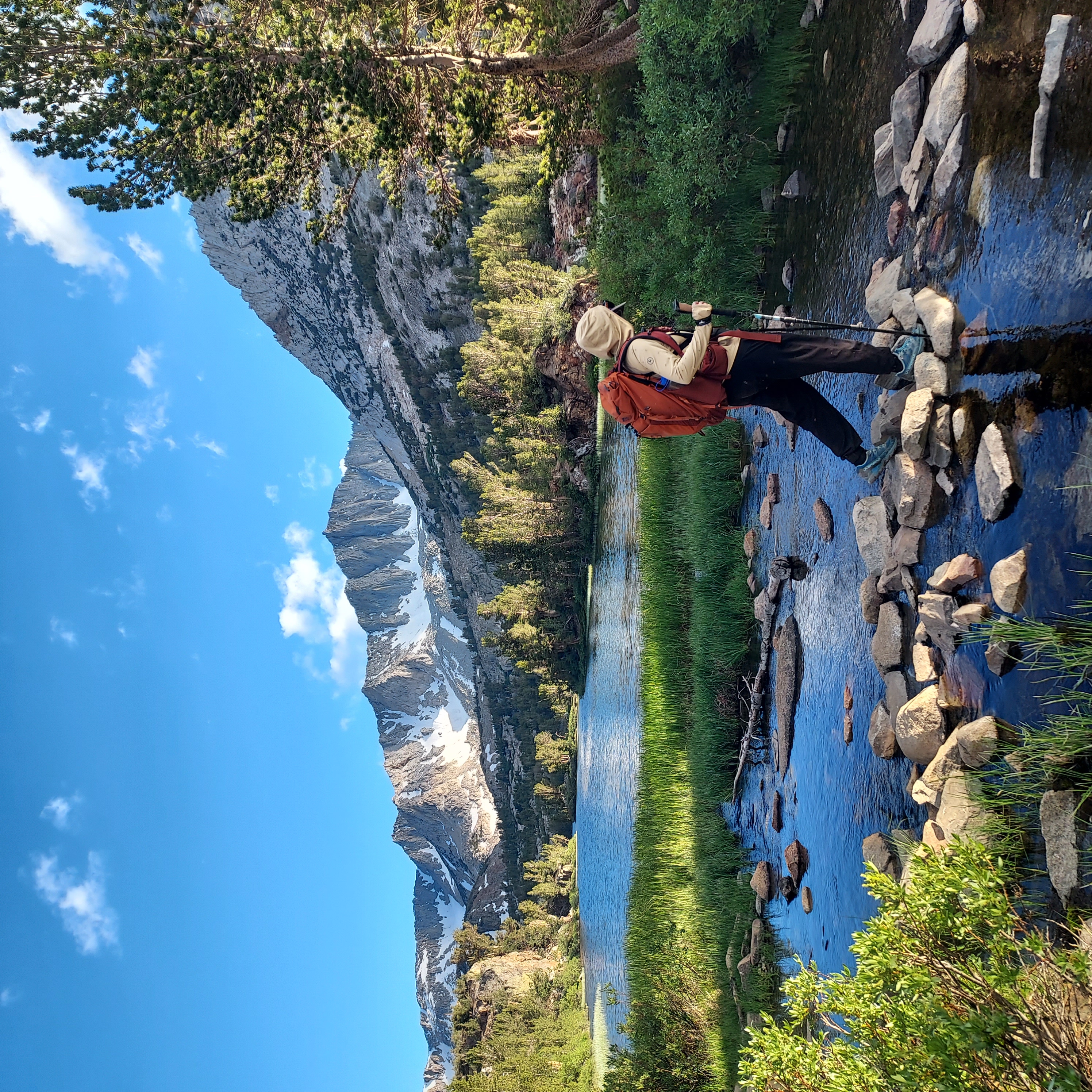
My favorite day was hiking a loop around Chocolate Peak (photos above). We paused frequently, admiring Mountain Bog Laurel, Clark’s Nutcrackers, and Lodgepole Pines. The hike expanded to fill the whole day; we had nowhere else to be.
Eventually, though, work called, and we returned back south to the research station.
Cottonwood Lakes
One day while I was at work, Connor went on an 18-mile solo hike out of the Cottonwood Lakes trailhead. It was higher elevation than the hike we had done a few days earlier, so there was more snow on the ground and different plants adapted to a harsher environment. He also spent some time watching Yellow-bellied Marmots and their babies! These ground squirrels only live at high elevations and hibernate for more than half the year.


Photos From the Kern River Valley
I have sent Connor lots of pictures and told him about life in the Kern River Valley, but nothing quite compares to showing him around in person.


Field Work Updates
Of course, no update would be complete without a few field photos!

In the picture above, I am weighing a Song Sparrow. This is the most common bird that we band in the preserve, and I appreciate their regularity for helping me with my pattern recognition. I am learning how to determine their age from their plumage and skull ossification, and my hands are much more confident when taking their measurements.

In this picture, I am holding a White-breasted Nuthatch. This is a species we have back home, and it is one of my favorites. I love watching them forage on tree trunks, and their nasally vocalizations make me laugh.
Western Yellow-Billed Cuckoos

Our Western Yellow-billed Cuckoo project is in full swing! For this project, not only do we survey to determine presence / absence , but we also attach radio transmitters to the birds to understand their movements. We can then use location to assist in finding their nests, so we can monitor nest productivity and take vegetation measurements. All this information will help conserve this genetically-distinct subset.

Here I am with a radio receiver. We stand on the highest point, and this receiver will tell us the direction of each bird along with the signal strength. This is also a great view from above of one of our survey plots. Southwestern riparian habitat is often described as a green ribbon in an otherwise desolate landscape, and this picture is a great example of that.
Favorite Nature Moments

About three weeks into living at the research station, I heard American Barn Owls screeching at night. They stuck around, seemingly centered around a dead tree with a large cavity in it. I suspected they had a nest, and last night as I was getting in bed, I heard an absolute Barn Owl ruckus. I went outside to find not two Barn Owls, but four! Some were perched just 15m away in a tree, and I watched another individual bring some kind of food over to them. Barn Owl fledglings! I ran inside to tell my roommate, and she came outside to join me as we both marveled at the magic owls always bring to life.

Last week I surveyed a site that was covered in bear tracks! When navigating the riparian forest, I am often searching for little windows in the vegetation to squeeze through, and I found myself often following in the bear’s footsteps. It had gone ahead of me and forged a trail. I could see where it had squished down the plants, and if I crawled to make myself shorter, I could also duck under the same branches.
As the season winds down, I’m soaking in these last few weeks of fieldwork and late summer sun. Thanks for following along. I can’t wait to share what comes next.